EN
EN



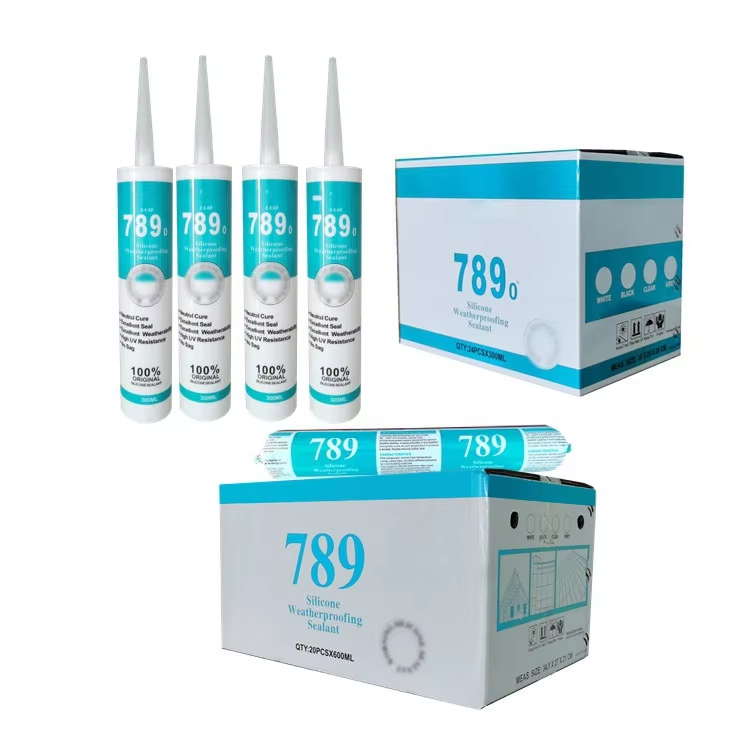
In the construction and building industry, material choices can make or break a project's long-term performance. Among the many adhesive and sealing solutions available today, Wacker silicone sealant has earned a reputation that extends far beyond marketing. Professional builders, contractors, and construction engineers consistently select this product for critical sealing applications — not out of habit, but because it delivers measurable, reliable results under real-world conditions. Understanding why this preference exists requires looking closely at what sets this material apart in terms of performance, versatility, and long-term durability.
The global adoption of Wacker silicone sealant is not limited to a single building type or climate zone. From high-rise curtain wall glazing in tropical cities to industrial facilities in sub-zero environments, professionals trust this sealant to maintain its integrity where other products often fail. This article explores the core reasons behind that worldwide professional preference, covering performance science, application versatility, economic value, and the practical decision-making logic that makes this sealant a standard on job sites across multiple industries.
The Science Behind Superior Silicone Performance
Temperature Resistance as a Baseline Expectation
One of the most fundamental reasons professional builders gravitate toward Wacker silicone sealant is its exceptional resistance to temperature extremes. Standard polymer-based sealants tend to harden, crack, or lose adhesion when exposed to sustained heat or repeated thermal cycling. Silicone, by its molecular nature, maintains flexibility and bond integrity across a far wider temperature range. This makes it uniquely suitable for applications around heating systems, industrial equipment, exterior facades, and automotive components where temperature fluctuations are constant.
High-temperature resistance is not just a feature that sounds impressive on a datasheet — it directly translates into reduced maintenance costs and fewer seal failures over the lifecycle of a building or installation. When a sealant retains its elastic properties even after years of heat exposure, building professionals know they won't be returning to rework the joint within a few years. That kind of longevity is a core reason why contractors with tight project margins and accountability to clients choose Wacker silicone sealant over lower-cost alternatives.
Builders working on commercial kitchens, exhaust systems, industrial ovens, or HVAC penetrations require sealants that simply will not degrade under heat. The ability of Wacker silicone sealant to perform reliably in these demanding thermal environments is a key differentiator that has solidified professional trust over decades of use in diverse market segments.
Waterproofing and Weather Barrier Performance
Moisture infiltration is one of the leading causes of structural damage, mold growth, and energy inefficiency in buildings. Professional builders take waterproofing extremely seriously, and the sealant they choose for joints, penetrations, and interfaces must perform without compromise. Wacker silicone sealant provides a durable, long-lasting water barrier that resists not only liquid water but also vapor transmission and humidity-driven degradation.
Unlike acrylic or polyurethane sealants that can swell, soften, or lose adhesion in consistently wet conditions, Wacker silicone sealant maintains its dimensional stability and bonding properties even in submerged or constantly damp environments. This makes it an ideal choice for wet-area applications such as bathrooms, roofing interfaces, swimming pool surrounds, aquarium construction, and marine environments. The cured silicone forms a hydrophobic surface that actively repels water rather than just resisting it passively.
For builders responsible for envelope performance — the critical barrier between interior conditioned space and exterior weather — the waterproofing reliability of Wacker silicone sealant provides both technical assurance and liability protection. Choosing a sealant known for consistent waterproofing performance is a professional decision that reflects on the quality standard of the entire project.
Versatility Across Building Applications
Glazing and Curtain Wall Systems
Modern architectural glazing systems demand sealants that can handle structural loads, thermal movement, UV exposure, and aesthetic requirements simultaneously. Wacker silicone sealant has become a trusted standard in structural and weather-seal glazing applications because it combines high tensile strength with the elasticity needed to accommodate building movement and thermal expansion. In curtain wall systems, where large glass panels are held in place by adhesive sealant rather than mechanical frames alone, the performance margin is critical.
The UV stability of silicone is another major factor in its adoption for glazing. Many sealant formulations yellow, chalks, or lose adhesion after prolonged ultraviolet exposure, creating both aesthetic and structural problems. Wacker silicone sealant is engineered to resist UV degradation, maintaining both its appearance and bond strength over the extended service life expected in commercial and institutional glazing projects.
Architects and facade engineers who specify sealants for high-profile glazing projects understand the consequences of product failure. Water ingress through a failed sealant joint in a curtain wall can cause extensive interior damage, structural deterioration, and significant remediation costs. The proven performance of Wacker silicone sealant in this application gives specifiers the confidence to commit to it in technically demanding and aesthetically visible installations.
Industrial and Manufacturing Environments
Beyond traditional construction, Wacker silicone sealant finds extensive application in industrial and manufacturing settings where chemical resistance, temperature tolerance, and mechanical durability are equally important. Equipment sealing, gasket replacement, machine housing joints, and clean-room installations all benefit from the combination of properties that silicone sealant provides in ways that general-purpose sealants cannot match.
Industrial facilities often expose sealants to oils, solvents, cleaning chemicals, and process fluids in addition to heat and mechanical stress. The chemical inertness of silicone makes Wacker silicone sealant resistant to a broad range of industrial substances without swelling, dissolving, or losing cohesion. This resistance profile reduces the frequency of maintenance interventions in production environments where downtime is costly.
Manufacturing professionals and plant maintenance teams who have experienced the failure of lower-grade sealants under chemical or thermal stress understand the operational cost of those failures. Switching to Wacker silicone sealant — or a product engineered to equivalent quality standards — is a decision driven by total cost of ownership rather than upfront material price alone. The reduction in reapplication frequency and associated labor costs justifies the investment clearly in high-throughput industrial environments.
Adhesion and Compatibility with Diverse Substrates
Bonding Performance on Construction Materials
A sealant is only as effective as its adhesion to the surfaces it connects. Professional builders work with a wide range of substrate materials — glass, aluminum, concrete, ceramic tile, stone, stainless steel, coated metals, and composite panels — and they need a sealant that bonds reliably to all of them without requiring excessive surface preparation. Wacker silicone sealant demonstrates strong adhesion across this substrate diversity, making it a practical choice for mixed-material construction assemblies.
The adhesion performance of Wacker silicone sealant is particularly valued in renovation and retrofit work, where new materials interface with aged or weathered surfaces that may not be in pristine condition. A sealant that bonds firmly to imperfect substrates reduces preparation time and risk of adhesion failure in real-world application conditions. This practical adhesion reliability is a significant reason why experienced professionals choose it over theoretically competitive alternatives that perform inconsistently in field conditions.
In facade systems that combine aluminum framing, glass panels, composite cladding, and concrete substrate elements, the ability of a single sealant product to provide reliable adhesion across all interfaces simplifies specification and quality control. Wacker silicone sealant supports this kind of multi-substrate application logic without requiring builders to maintain inventories of multiple specialized products for different joint types.
Elasticity and Joint Movement Accommodation
Buildings are not static structures. They move — due to thermal expansion, wind loading, seismic activity, foundation settlement, and live load deflection. Sealant joints in modern construction must be able to accommodate this movement repeatedly and reversibly without cracking, delaminating, or losing their seal. The high elasticity of Wacker silicone sealant makes it inherently suited to this dynamic role in building envelope and interior construction.
The elongation capacity and recovery rate of silicone sealants exceed those of most organic polymer sealants, meaning joints sealed with Wacker silicone sealant can stretch significantly and then return to their original dimensions without permanent deformation. For expansion joints, movement joints, and perimeter seals around windows and doors, this property is not optional — it is the defining performance requirement. Builders who have experienced sealant cracking in these applications due to inadequate movement accommodation understand the value of specifying a product with proven elastic performance.
The combination of strong adhesion and high elasticity is not easy to achieve simultaneously in sealant formulation. It requires careful material science and consistent quality control. This is precisely why professionals who understand sealant performance requirements return consistently to Wacker silicone sealant for applications where both properties must coexist without compromise.
Practical Application Qualities That Professionals Value
Workability and Application Consistency
From a craftsman's perspective, a sealant must not only perform after curing — it must also apply cleanly, tool smoothly, and cure predictably. Builders who apply sealant every day know the difference between products that work with them and those that fight them. Wacker silicone sealant is formulated with a consistency that supports clean bead application, smooth tooling, and reliable skinning times that allow finishers to work at a natural pace without rushing before the surface skins over.
In high-production environments such as glazing manufacturing, facade panel assembly, or modular building construction, application speed and consistency are productivity factors with direct cost implications. A sealant that applies uniformly, resists slump in vertical joints, and tools to a clean finish without dragging or pulling saves labor time and reduces material waste. These workability advantages of Wacker silicone sealant contribute to its preference in professional settings where both quality and productivity are measured.
The predictability of cure behavior under varying temperature and humidity conditions is another workability factor that professionals appreciate. Inconsistent cure times create scheduling uncertainties on job sites where multiple trades must coordinate. A sealant that cures reliably within expected timeframes allows project managers to plan subsequent work steps with confidence, reducing idle time and schedule risk.
Availability in Clear and White Formulations
Aesthetic compatibility is a practical requirement in finishing trades, and the availability of Wacker silicone sealant in clear and white formulations gives builders the flexibility to match sealant appearance to design intent. Clear silicone is the standard choice for glass-to-glass joints, aquarium edges, and applications where the substrate should remain visible. White silicone serves sanitary ware joints, window frames, and interior finishing work where a clean, neutral appearance is required.
The non-yellowing characteristics of quality silicone formulations mean that clear and white sealants retain their original appearance over time, avoiding the discolored, aged look that plagues lower-quality alternatives. In visible applications such as shower enclosures, kitchen backsplashes, and architectural glazing, the long-term color stability of Wacker silicone sealant protects the aesthetic quality of finished work and reduces the likelihood of callbacks driven by cosmetic deterioration.
For specifiers and builders focused on maintaining design quality across the full lifecycle of an installation, choosing a sealant with stable color and surface characteristics is as important as its structural or waterproofing performance. The availability of consistent clear and white options in Wacker silicone sealant supports professional finishing standards without requiring trade-offs between appearance and performance.
Economic and Long-Term Value Considerations
Total Cost of Ownership vs. Unit Price
Professional builders and procurement managers experienced in material selection understand that unit price is only one component of material cost. When sealant failure requires remediation — removing failed sealant, repairing underlying damage, reapplying new material, and potentially absorbing warranty claims — the total cost of a cheaper sealant decision multiplies rapidly. Wacker silicone sealant commands a position in the professional market not because it is the cheapest option but because it consistently delivers the lowest total cost of ownership over realistic application lifecycles.
In commercial projects where sealant performance is tied to warranties, latent defect liability, and handover inspections, specifying a product with a proven performance record protects contractors from post-completion financial exposure. The durability and adhesion consistency of Wacker silicone sealant reduces the probability of in-warranty failures that consume profit margins and damage client relationships. Professional builders who think in terms of project profitability rather than line-item material savings repeatedly come back to this sealant for exactly that reason.
The longer service intervals enabled by high-performance silicone sealant also reduce the lifecycle maintenance cost for building owners. Facilities managers and property developers who receive buildings sealed with quality silicone products benefit from extended intervals between resealing cycles, reducing both direct material and labor costs over the building's operational life. This long-term value proposition strengthens the professional preference for Wacker silicone sealant at the specification and procurement stage.
Consistency and Quality Assurance
In professional construction, consistency of product quality across batches and supply chains is as important as the quality of any individual sample. A sealant that performs excellently on one project but shows variable adhesion or cure behavior on another creates unpredictable risk for builders who rely on it across multiple projects and sites. The manufacturing discipline and quality control standards associated with Wacker silicone sealant production provide the batch-to-batch consistency that professionals require for repeatable results.
Quality assurance in sealant production encompasses raw material control, formulation consistency, rheology testing, adhesion testing, and accelerated aging verification. When builders and specifiers select a product aligned with recognized quality benchmarks, they are buying documented, verified consistency rather than hoping for it. This assurance becomes particularly important on large or complex projects where hundreds of linear meters of sealant joint must perform to the same standard throughout.
The worldwide adoption of Wacker silicone sealant by professional builders is therefore not simply a matter of brand recognition — it reflects a sustained, verified quality performance that has been validated across diverse geographies, climates, applications, and building types. Professionals who have tested this sealant against the demands of real projects continue to choose it because the results consistently justify the specification decision.
FAQ
What makes Wacker silicone sealant suitable for both interior and exterior applications?
The combination of UV resistance, temperature tolerance, high elasticity, and waterproofing performance makes Wacker silicone sealant effective across both interior wet areas — such as bathrooms and kitchens — and exterior applications like curtain wall glazing, facade joints, and roofing interfaces. Its substrate adhesion versatility further supports this cross-application utility without requiring different products for different zones of a building.
How does Wacker silicone sealant perform in high-temperature industrial environments?
Wacker silicone sealant retains its flexibility and adhesion at elevated temperatures that would cause organic polymer sealants to harden, crack, or lose bond. This makes it suitable for sealing around heating equipment, exhaust systems, industrial ovens, and HVAC penetrations where sustained heat exposure is a constant operating condition rather than an occasional event.
Is Wacker silicone sealant appropriate for structural glazing applications?
Yes. The high tensile strength, UV stability, and movement accommodation capacity of Wacker silicone sealant make it a technically appropriate choice for structural and weather-seal glazing systems. In curtain wall and structural glazing applications, it provides the adhesive and elastic performance required to support glass panels and accommodate building movement over the intended service life of the facade system.
What is the difference between clear and white Wacker silicone sealant formulations?
Both formulations share the same core performance properties — temperature resistance, waterproofing, elasticity, and adhesion. The primary difference is aesthetic. Clear Wacker silicone sealant is used in glass-to-glass joints and transparent applications where the substrate should remain visible, while white is used in sanitary, window frame, and interior finishing applications where a clean neutral appearance is desired. Both formulations are engineered to resist color change and yellowing over time.
Table of Contents
- The Science Behind Superior Silicone Performance
- Versatility Across Building Applications
- Adhesion and Compatibility with Diverse Substrates
- Practical Application Qualities That Professionals Value
- Economic and Long-Term Value Considerations
-
FAQ
- What makes Wacker silicone sealant suitable for both interior and exterior applications?
- How does Wacker silicone sealant perform in high-temperature industrial environments?
- Is Wacker silicone sealant appropriate for structural glazing applications?
- What is the difference between clear and white Wacker silicone sealant formulations?