EN
EN



When it comes to managing heat transfer and unwanted noise, few materials have proven as versatile and effective as polyurethane foam. Across a wide range of industrial, commercial, and automotive applications, this material has become a go-to solution for engineers and builders who need reliable performance in demanding conditions. Understanding how polyurethane foam achieves these insulation goals requires a closer look at its physical structure, chemistry, and the practical ways it integrates into real-world systems.
The performance advantages of polyurethane foam stem from its unique cellular architecture. Whether in rigid or flexible form, this material traps air or gas within millions of tiny closed or open cells, creating a barrier that resists the movement of heat and sound with remarkable efficiency. This core characteristic makes polyurethane foam an indispensable component in building construction, automotive manufacturing, refrigeration, and even marine applications where thermal stability and acoustic comfort are critical priorities.
The Science Behind Polyurethane Foam as a Thermal Insulator
How Cellular Structure Reduces Heat Transfer
The insulating power of polyurethane foam begins at the microscopic level. Its structure consists of an intricate network of polymer cells that are either closed or open, depending on the intended application. Closed-cell polyurethane foam is particularly effective at blocking conductive and convective heat transfer because the gas trapped within each sealed cell cannot circulate freely, thereby minimizing thermal conductivity.
Thermal conductivity values for rigid closed-cell polyurethane foam typically range among the lowest of any commercially available insulation material. This low lambda value means that a relatively thin layer of the material can achieve insulation performance equivalent to much thicker sections of traditional materials like fiberglass batts or mineral wool. For architects and engineers working within tight spatial constraints, this translates directly into more usable interior space without sacrificing thermal performance.
The polymer matrix itself also plays a role. Polyurethane's molecular backbone is resistant to thermal degradation across a wide temperature range, which means the insulation value of polyurethane foam does not diminish significantly under real-world operating conditions, whether in a cold-storage facility or a sun-exposed rooftop installation.
Thermal Bridging Prevention and Continuous Insulation
One of the most practical advantages of spray-applied polyurethane foam is its ability to form a seamless, continuous layer over complex surfaces. Traditional rigid board insulation leaves gaps at joints, fasteners, and framing members, creating thermal bridges where heat bypasses the insulation layer. Spray polyurethane foam eliminates this problem by conforming to irregular geometries and sealing every penetration in a single application pass.
In automotive contexts, polyurethane foam fills cavities in door panels, headliners, and floor assemblies, preventing localized heat transfer from the engine bay or external environment into the passenger compartment. The continuous coverage achievable with injectable or spray-applied formulations ensures that no cold or hot spots develop over time, supporting consistent thermal comfort across the entire vehicle interior.
This same principle applies to industrial refrigeration units and cold-chain logistics containers, where maintaining precise temperature ranges is economically critical. A well-applied layer of polyurethane foam reduces the energy load on refrigeration systems by minimizing heat ingress, cutting operating costs and improving sustainability metrics simultaneously.
Acoustic Performance Mechanisms of Polyurethane Foam
Sound Absorption Versus Sound Blocking
It is important to distinguish between two distinct acoustic functions when evaluating polyurethane foam: sound absorption and sound blocking. Open-cell polyurethane foam excels at sound absorption. When sound waves enter the open cellular network, they cause the air within the cells to vibrate. This vibration converts acoustic energy into a small amount of heat through friction, effectively reducing the amplitude of sound waves that pass through or reflect from the material.
This mechanism makes open-cell polyurethane foam ideal for applications where echo reduction and reverberation control are priorities, such as recording studios, office spaces, and vehicle cabins. The material's ability to absorb mid- and high-frequency sound energy is particularly well-suited to human speech frequencies, which are the most disruptive in professional and residential environments.
Closed-cell polyurethane foam, on the other hand, contributes more to sound isolation — the blocking of airborne sound transmission between spaces — due to its higher mass and rigidity. In combination systems where both absorption and isolation are needed, layering open-cell and closed-cell polyurethane foam products can deliver broadband acoustic performance that neither material achieves alone.
Vibration Damping and Structure-Borne Noise Reduction
Beyond airborne sound, polyurethane foam is highly effective at damping structure-borne noise and mechanical vibration. In automotive and industrial machinery applications, vibrating components transmit energy through surrounding structures, creating resonant noise that is difficult to control with conventional insulation methods. Polyurethane foam's viscoelastic properties allow it to absorb and dissipate this mechanical energy before it can radiate as audible noise.
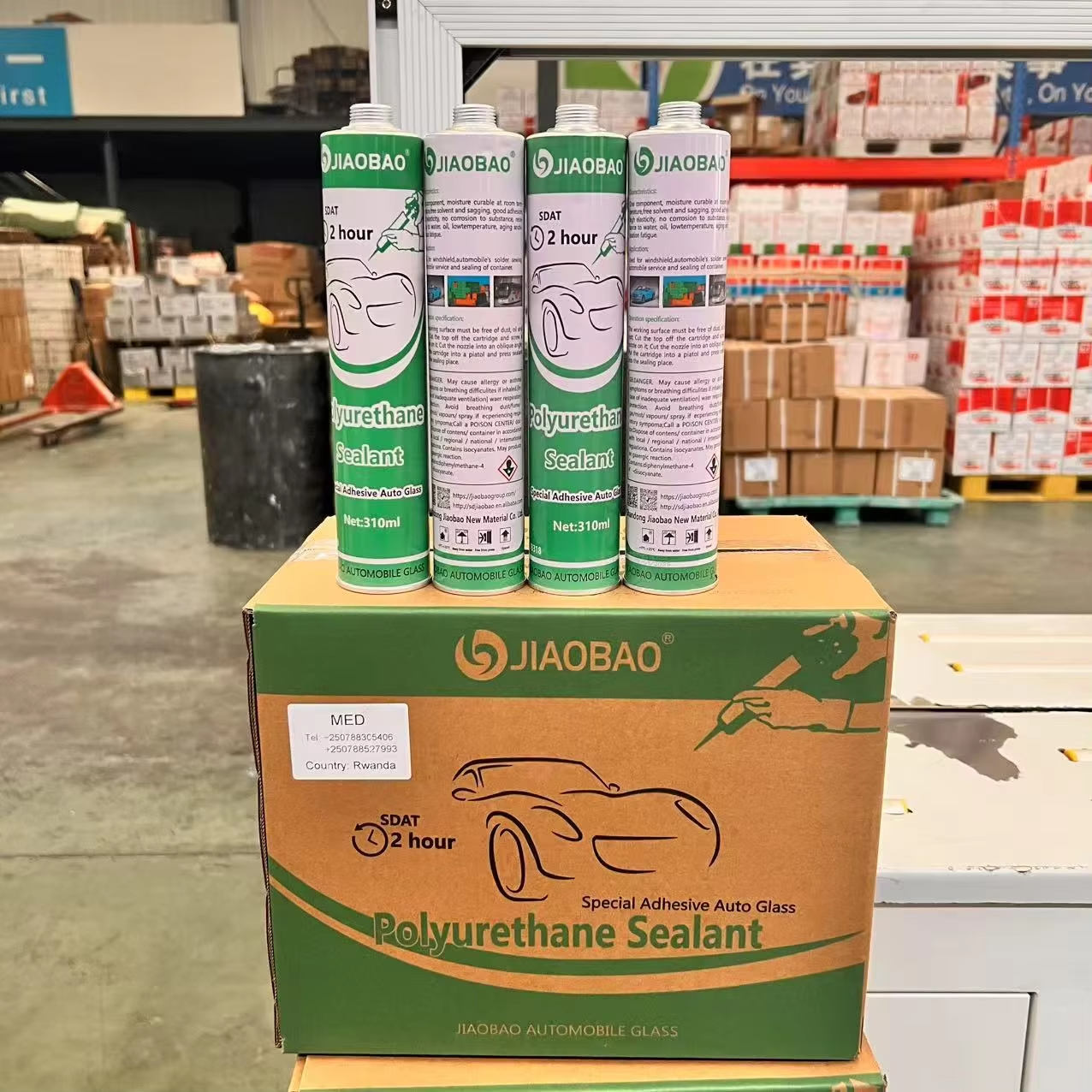
When applied as a sealant or gap filler around windows, windshields, or panel seams — as seen in applications involving polyurethane foam-based adhesive compounds — this material also eliminates the micro-gaps that allow vibration-induced rattles and wind noise to intrude into enclosed spaces. The dual function of adhesion and acoustic sealing makes it an especially valuable tool in automotive glass installation and roof assembly work.
In building construction, polyurethane foam injected into wall cavities dramatically reduces the transmission of low-frequency structural vibration from external sources such as traffic, HVAC equipment, and industrial machinery. The result is a measurably quieter indoor environment without the need for heavy, expensive mass-loaded vinyl or concrete construction.
Application Methods That Maximize Insulation Effectiveness
Spray Application for Building Envelopes
Spray-applied polyurethane foam has become the preferred insulation method for complex building envelopes, attic assemblies, and foundation walls. The two-component spray system combines an isocyanate compound with a polyol resin on-site, creating an expanding foam that adheres to virtually any substrate and cures in place within seconds. This process allows installers to achieve precise, uniform coverage across surfaces that would be impossible to insulate effectively with pre-cut boards.
The rapid expansion characteristic of spray polyurethane foam also means that it self-seals around penetrations, electrical conduits, plumbing lines, and structural members without requiring additional tape, caulk, or vapor barriers in many applications. This simplification of the installation process reduces labor time and minimizes the risk of installation errors that compromise long-term thermal and acoustic performance.
From a building code perspective, spray polyurethane foam is now recognized in most major construction standards as a compliant continuous insulation method, and its performance credentials are well-established through standardized testing protocols. This regulatory acceptance has accelerated its adoption in green building projects where energy efficiency targets are legally mandated.
Pour-in-Place and Injectable Foam for Sealed Cavities
For applications where access to the cavity is limited — such as existing wall assemblies, automotive door panels, or sealed industrial enclosures — pour-in-place and injectable polyurethane foam systems offer a practical alternative. These formulations are introduced through small drill holes or pre-designed ports and then expand to fill the available space, conforming perfectly to irregular cavity shapes.
Injectable polyurethane foam is particularly valuable in retrofit insulation projects where opening up walls for conventional insulation would be disruptive and costly. Contractors can achieve significant improvements in both thermal and acoustic performance with minimal disturbance to finished interior surfaces. The foam cures to a stable, dimensionally consistent form that does not settle or shift over time, unlike loose-fill alternatives.
In the automotive sector, pour-in-place polyurethane foam is used extensively during vehicle assembly to fill body cavities that would otherwise act as resonating chambers amplifying road noise and wind noise. The precise control over foam density and expansion ratio enables manufacturers to tune acoustic response characteristics without adding significant weight to the vehicle structure.
Long-Term Durability and Performance Stability of Polyurethane Foam Insulation
Resistance to Moisture, Aging, and Dimensional Change
A critical factor in choosing any insulation material is its ability to maintain performance over decades of service. Closed-cell polyurethane foam demonstrates exceptional resistance to moisture absorption, which is a primary cause of insulation failure in materials such as mineral wool and cellulose fiber. The closed cellular structure physically prevents liquid water and water vapor from penetrating the material core, preserving thermal resistance values over the long term.
UV exposure can degrade the surface of exposed polyurethane foam over time, but this surface oxidation does not typically penetrate deeply into the material or compromise its core insulation value. When a protective facing or coating is applied — as is standard practice in roofing and exterior wall applications — the underlying polyurethane foam retains its original performance characteristics for the design life of the building.
Dimensional stability is another strength of rigid polyurethane foam systems. Unlike organic insulation materials that can compress, settle, or warp under load, properly formulated polyurethane foam maintains its thickness and density under normal service conditions. This means the thermal and acoustic values measured at installation remain representative of actual in-service performance throughout the product's lifecycle.
Compatibility with Adhesive Sealant Systems
In many modern construction and automotive applications, polyurethane foam does not function in isolation. It is frequently used in combination with polyurethane-based adhesive sealants that bond structural components while simultaneously providing secondary thermal and acoustic insulation at joint lines. This combination approach is standard in automotive glass installation, where the adhesive must manage structural loads, prevent water ingress, and minimize vibration transmission simultaneously.
The chemical compatibility between polyurethane foam cores and polyurethane adhesive systems ensures excellent interfacial adhesion without the risk of delamination or chemical degradation over time. This compatibility simplifies material selection for system designers who want to optimize both structural and insulation performance using a chemically coherent material family.
When windshield assemblies, skylights, or roof panels are sealed with polyurethane adhesive compounds applied over a polyurethane foam substrate or cavity fill, the resulting system delivers layered protection against heat transfer, moisture infiltration, and acoustic intrusion — addressing three distinct performance requirements with a unified material approach that simplifies quality control and long-term maintenance.
FAQ
What is the difference between open-cell and closed-cell polyurethane foam for insulation?
Open-cell polyurethane foam has an interconnected cellular structure that excels at absorbing sound and providing air sealing at lower cost. Closed-cell polyurethane foam has sealed individual cells that offer superior thermal resistance, moisture resistance, and structural rigidity. For thermal insulation in demanding environments, closed-cell formulations are generally preferred, while open-cell versions are better suited to interior acoustic applications where moisture exposure is minimal.
Can polyurethane foam be used in automotive applications for both heat and noise control?
Yes, polyurethane foam is widely used in automotive manufacturing and aftermarket applications to address both thermal management and noise, vibration, and harshness reduction. It is applied in door cavities, headliners, floor assemblies, and around glass installations to reduce heat transfer from the engine compartment and external environment while simultaneously damping structure-borne vibration and blocking airborne noise intrusion.
How does polyurethane foam compare to traditional fiberglass insulation in thermal performance?
Closed-cell polyurethane foam typically delivers significantly higher thermal resistance per unit thickness compared to fiberglass batt insulation. This means thinner applications of polyurethane foam can achieve equivalent or superior R-values, making it particularly advantageous in space-constrained applications. Additionally, polyurethane foam forms a continuous insulation layer that eliminates thermal bridging, a limitation inherent to batt-style insulation installed between structural framing members.
Is polyurethane foam suitable for retrofit insulation in existing buildings?
Injectable and spray-applied polyurethane foam are both well-suited to retrofit insulation projects. Injectable formulations can be introduced into existing wall cavities through small access holes with minimal disturbance to finished surfaces. Spray polyurethane foam can be applied in attic spaces, crawlspaces, and exposed wall assemblies during renovation projects. Both methods deliver significant improvements in thermal and acoustic performance in existing structures without requiring full demolition and rebuilding of wall or ceiling assemblies.
Table of Contents
- The Science Behind Polyurethane Foam as a Thermal Insulator
- Acoustic Performance Mechanisms of Polyurethane Foam
- Application Methods That Maximize Insulation Effectiveness
- Long-Term Durability and Performance Stability of Polyurethane Foam Insulation
-
FAQ
- What is the difference between open-cell and closed-cell polyurethane foam for insulation?
- Can polyurethane foam be used in automotive applications for both heat and noise control?
- How does polyurethane foam compare to traditional fiberglass insulation in thermal performance?
- Is polyurethane foam suitable for retrofit insulation in existing buildings?